A temp was brought in to cover the fleet administrator's annual leave. Helpful, capable, got on with it. They were given full access to FleetEase — vehicles, drivers, the lot. Nobody thought twice about it.
Three weeks later, the permanent admin came back and noticed something was off. A driver's licence number had been changed. An emergency contact phone number was different. An address had been updated. A date of birth had been modified. Were these corrections? Were they mistakes? Were they something else entirely? On a spreadsheet, nobody would ever know. The old values would simply be gone — overwritten, with no trace of who changed them, when, or why.
In FleetEase, every one of those changes was logged automatically. The Change History tab on the driver record showed exactly what happened: "Licence number changed from HUGHE951239RH4KL to HUGHE951239RH4LL — 31 Jul 2026, 20:11 — by Test User." "Emergency contact phone changed from 07700123106 to 07700123177 — 31 Jul 2026, 20:11 — by Test User." Each change timestamped. Each change attributed. Each change showing the old value and the new value, side by side, in red and green.
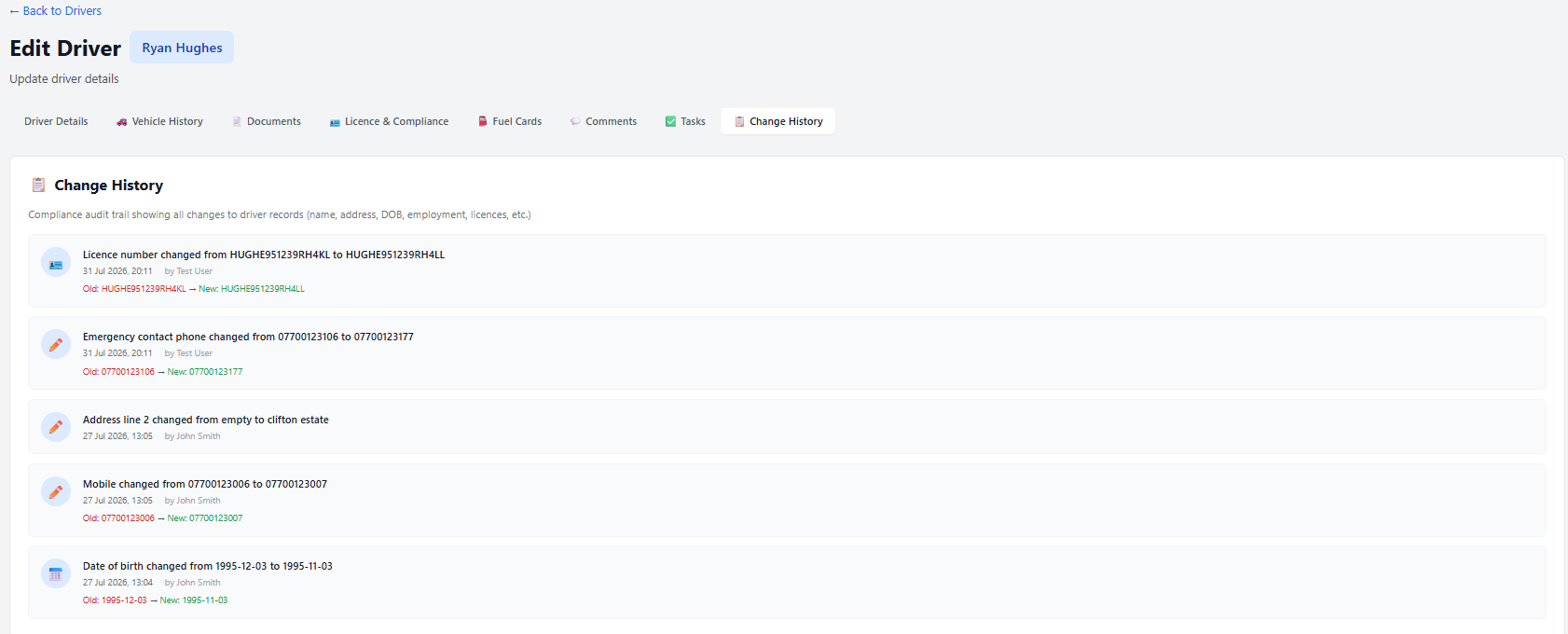
The issue was identified within minutes. The temp had made well-intentioned corrections based on outdated paperwork — not malicious, just wrong. The changes were reversed. Two-factor authentication was enabled for all accounts. Access permissions were reviewed. And when the next compliance audit came around, the auditor didn't just see that the data was correct — they saw that the business had detected a problem, traced it through the audit trail, resolved it, and tightened controls. That's a glowing review. That's what demonstrable governance looks like.
On Excel, the same scenario ends with "we think someone might have changed something, but we're not sure what, or when, or who." Try presenting that to a DVSA examiner.
Who Actually Audits Your Fleet Data?
If you hold an O-Licence, your fleet records can be scrutinised by a surprisingly wide range of people — and most of them won't give you notice.
DVSA examiners. Roadside inspections and desk-based assessments can happen at any time. The examiner wants to see maintenance records, walkaround check logs, driver licence records, and defect resolution trails. They're checking whether your systems are real or cosmetic. A timestamped digital audit trail is the difference between a 30-minute review and a day-long investigation.
Traffic Commissioners. When your O-Licence comes up for review, or if you're called to a Public Inquiry, the Traffic Commissioner expects documented evidence of systematic compliance. They will ask to see records — and increasingly, they mandate formal audits carried out by DVSA Earned Recognition auditors. There are only around 30 approved providers in the UK qualified to conduct these audits. Their standard of evidence is high, and "we had it on a spreadsheet but the file got corrupted" is not an answer they accept.
FORS auditors. If you hold or are pursuing FORS accreditation (Bronze, Silver, or Gold), auditors will review your fleet management systems, driver training records, vehicle maintenance documentation, and incident reporting processes. Digital audit trails with timestamped records are exactly what they want to see.
Client and customer auditors. Large companies that subcontract transport — supermarkets, construction firms, logistics providers — increasingly audit their supply chain partners' fleet compliance. If you're carrying goods for Tesco or working on a Balfour Beatty site, their auditors may review your vehicle records, driver documentation, and maintenance history. Being able to pull up a complete, auditable record instantly makes the difference between keeping the contract and losing it.
Insurance assessors. After an accident or when renewing your fleet policy, insurers may review your fleet management practices, maintenance history, driver records, and incident documentation. A comprehensive audit trail demonstrates due diligence, which can directly affect your premium.
ISO auditors. If your business is pursuing ISO 9001 (quality management) or ISO 14001 (environmental management) certification, auditors will review your documented processes including fleet operations. Auditable, systematic record-keeping is a core requirement.
Internal audit and governance. Larger operators and those with board-level governance requirements conduct their own internal audits. Being able to demonstrate who accessed what, who changed what, and when — across every driver and vehicle record — is fundamental to any internal assurance process.
What Gets Audited in FleetEase
FleetEase tracks changes to the data that matters most for compliance and governance:
Driver records. Every change to a driver's name, address, date of birth, contact details, emergency contacts, licence number, licence categories, employment details, and compliance fields is logged with a timestamp, the user who made the change, the old value, and the new value. If someone modifies a driver's licence number from one value to another, the audit trail captures both — permanently.
Vehicle records. Changes to registration details, assigned driver, MOT dates, tax status, insurance details, mileage entries, and HGV-specific fields (axle configuration, MAM, tachograph calibration) are all tracked. When an MOT date is updated from one value to another, you can see who did it, when they did it, and what the previous value was.
This isn't a feature you enable or configure. It's on by default, for every company, from day one. You can't turn it off, you can't delete audit entries, and you can't modify historical records. The trail is immutable.
Built on a Compliance-Grade Tech Stack
FleetEase is built on a modern, cloud-native technology stack where security and compliance are baked into the infrastructure — not bolted on afterwards. Every layer of the platform, from the application servers to the database, is independently certified to internationally recognised standards: ISO/IEC 27001 (information security management), ISO/IEC 27701 (privacy information management), SOC 2 Type 2 (operational effectiveness of security controls), and full GDPR compliance for UK and EU data protection.
All data is encrypted in transit using TLS and at rest using AES-256 encryption. User access is controlled through role-based permissions — not every user needs access to every module, and you can restrict who can view driver personal data, who can modify vehicle records, and who can see financial information. Two-factor authentication is available for all accounts, and after the temp staff scenario described earlier, you can see why enabling it from day one is worth the thirty seconds it adds to each login.
When the DVSA examiner or the FORS auditor asks "how is this data protected?" — you have a clear, certifiable answer. Most fleet management spreadsheets are stored on someone's laptop, backed up to a USB stick in a desk drawer. FleetEase runs on infrastructure that has been independently audited by third-party security assessors — and passed.
Why This Matters for Small Fleets
You might be thinking "we're a 20-van operation, not a bank — do we really need ISO 27001-grade security?" The answer is: you need it more than the big operators, not less.
Large fleets have dedicated IT departments, compliance officers, and data protection staff. They can implement security controls internally. Small and mid-sized operators — the person running 15 vans from a portakabin on an industrial estate — don't have that luxury. You rely on the software you choose to handle security for you. If your fleet management tool runs on a shared hosting platform with no security certifications and stores your drivers' personal data in an unencrypted database, you're carrying a GDPR liability you probably don't even know about.
FleetEase pushes the compliance burden onto the infrastructure. You don't need to think about encryption standards, security certifications, or data retention policies — the platform handles it. What you get is the ability to tell the auditor, the examiner, or the client: "Our fleet data is stored on ISO 27001 and SOC 2 Type 2 certified infrastructure, encrypted at rest and in transit, with role-based access controls and a full change audit trail." And you can say it with a straight face, because it's true.
The Spreadsheet Comparison
Let's be blunt about what you're comparing against.
Excel / Google Sheets vs FleetEase:
❌ Audit trail: None. Overwritten values are gone forever.
❌ Access control: Anyone with the file can change anything.
❌ Encryption: None (unless you password-protect the file).
❌ GDPR compliance: Storing driver personal data in a spreadsheet shared via email is a data protection breach waiting to happen.
❌ Backup: Whatever you last saved to the USB stick.
❌ Certifications: None.
✅ FleetEase: Full change audit trail, role-based access, TLS + AES-256 encryption, ISO 27001, SOC 2 Type 2, GDPR, automated backups, 2FA.
£25/month — less than the cost of a single GDPR breach notification.
When the Auditor Sits Down
Whether it's a DVSA desk-based assessment, a Traffic Commissioner mandated audit, a FORS accreditation review, a client supplier audit, or an internal governance check — the moment someone asks to see your fleet records, two things determine how the next hour goes.
First: can you produce the records instantly? Not "give me ten minutes to find the file" or "I'll need to print that off for you." Instantly. On screen. FleetEase gives you every vehicle, every driver, every walkaround check, every maintenance job, every fuel entry, every incident — searchable, filterable, on your phone or laptop.
Second: can you prove the records haven't been tampered with? This is where most operators fall down. A PDF that was "exported last week" doesn't prove the data was accurate at the time of the event it records. A spreadsheet that's been edited seventeen times doesn't prove what was in it six months ago. An audit trail with timestamped, attributed, immutable change records proves exactly that. It's the difference between "here are our records" and "here are our records, and here's the proof they're authentic."
That's what compliance looks like in 2026. Not a filing cabinet. Not a spreadsheet. A system that records everything, tracks every change, runs on certified infrastructure, and produces evidence on demand. For £25/month.
Your Records Should Speak for Themselves.
Start your free 30-day trial. Full audit trail from day one. ISO 27001 infrastructure. No credit card required.
Start Free Trial →